

 24 Hours
 (In-Stock)

Placing regulatory buoys on any public waterway means answering to two separate authorities before the first anchor drops. The United States Coast Guard governs federal navigable waters, while state agencies control markers on inland lakes and rivers within their borders. Missing either layer of approval turns a well-intentioned safety installation into an unpermitted obstruction subject to removal and fines.
Marina operators, lake associations, and municipal buyers often underestimate how specific the rules actually get. Color, shape, symbol size, lettering, and reflectivity all carry federal specifications that state codes then layer additional requirements on top of. Understanding regulatory buoy requirements from the start protects your budget, your compliance record, and the boaters you are trying to keep safe.
What Are Regulatory Buoys and What Standards Must They Meet?
Regulatory buoys are white markers with international orange bands and geometric symbols that communicate rules or warnings to vessel operators on the water. USCG buoys must meet federal specifications for shape, color, and symbology under 33 CFR Part 66, which governs the United States Aids to Navigation System. State agencies like the Wisconsin DNR add permit requirements and placement approvals under statutes such as NR 5.09.
The Four Symbols Every Regulatory Buoy Must Display
Federal and state codes recognize four core symbols that give regulatory buoys their meaning on the water. Each symbol combines international orange geometry with a white background to communicate danger, restriction, control, or information at a glance.
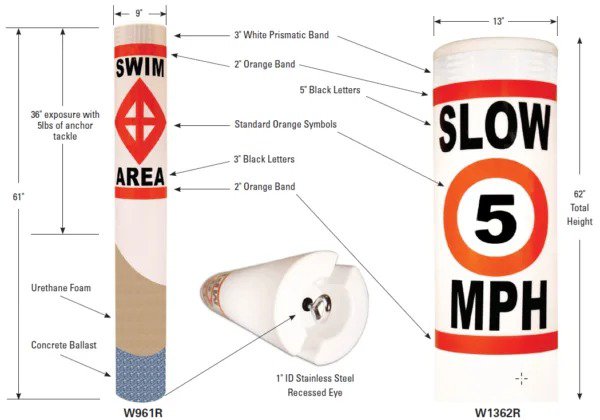
Learning the four shapes protects boaters and keeps your installation aligned with the standards inspectors check first.
- Diamond (Danger) – An orange diamond outline with a white center warns boaters of hazards like rocks, shoals, or submerged wrecks. Black lettering inside or above the diamond names the specific danger, from "ROCK" to "DAM" to "SHOAL."
- Diamond With Cross (Exclusion Zone) – An orange diamond containing an orange cross marks areas where all vessels are prohibited from entering. Common uses include swimming areas, spillways, and other zones where boat traffic creates unacceptable safety risks.
- Circle (Controlled Area) – An orange circle indicates a controlled operation such as a no-wake zone, speed limit, or ski-only area. Black lettering inside the circle spells out the specific rule, giving operators clear direction without ambiguity.
- Rectangle (Information) – An orange rectangle conveys non-restrictive information about place names, distances, directions, or points of interest. Regulatory buoys carrying rectangles help orient boaters without imposing rules, and they often mark channel entrances or landmarks.
Every symbol pairs with reflective materials, standardized dimensions, and legible black lettering under federal specifications. When these elements are missing or faded, your regulatory buoys stop communicating what the code requires them to communicate. Refreshing graphics on a routine schedule keeps your markers legally effective and visually clear from a safe distance.
USCG Regulatory Buoys and the Federal Standards Behind Them
The United States Aids to Navigation System (USATONS) sets the federal baseline for regulatory buoys and markers on navigable waters. USCG buoys must comply with 33 CFR Part 66, which governs private aids to navigation and standardizes shape, color, and symbology across all fifty states. Compliance is not optional on any waterway the Coast Guard considers navigable, and violations carry real enforcement consequences.
Shape and color carry specific meaning under the federal code, and departures from the specification create legal exposure. A white buoy with international orange markings signals a regulatory function, while solid red, green, or black colors serve navigational purposes entirely. Mixing these categories confuses operators and undermines the standardized language boaters rely on nationwide.
Reflectivity and lighting requirements also fall under federal jurisdiction on many waters. Red lights pair only with solid red buoys, green lights pair with green or black buoys, and white lights cover everything else.
Every private aid on navigable water must be authorized through Coast Guard Form CG-2554, submitted at least 30 days before installation. The application requires location coordinates, structural details, and evidence of state and Army Corps approvals where applicable. Missing paperwork can result in permit denial, forced removal, and civil penalties assessed by the district commander.
How Wisconsin Layers State Rules on Top of Federal Regulatory Buoy Requirements
Wisconsin adds its own layer of regulatory buoy requirements through Chapter NR 5.09 of the Wisconsin Administrative Code. State rules mirror the federal shape and color scheme but add permitting steps, identification numbering, and placement approvals administered by the Department of Natural Resources. Every approved marker carries a DNR-assigned identification number visible to conservation wardens during routine inspections.
The DNR requires a Waterway Marker Application (Form 8700-058) for regulatory buoys, aids to navigation, and hazard markers placed on public inland waters. Applicants submit the form to their local conservation county warden, along with diagrams and satellite maps showing exact placement coordinates. Approval flows through the county warden to the DNR, which issues the final permit and records it on file.
Wisconsin also restricts who can apply for which marker type under the state code. Generally, only municipalities may apply for aids to navigation, controlled area buoys, and boat exclusion markers on public water. Individuals, resorts, clubs, and civic organizations may apply for hazard warning markers and informational buoys under a narrower set of circumstances.
Mooring buoys receive separate treatment under NR 5.09(6), which requires them to be spherical or ovate, white, and marked with a blue band. The design intentionally prevents confusion between mooring buoys and true regulatory markers. Similar layered logic runs through most state boating codes across the country, so buyers outside Wisconsin should check their own state administrative rules before ordering.
Permitting and Placement: Getting Your Regulatory Buoys Approved
Getting regulatory buoys approved starts with identifying which agency has jurisdiction over your specific waterway. Federal navigable waters fall under Coast Guard authority, inland state waters fall under agencies like the Wisconsin DNR, and some waters trigger both. Local municipalities may add their own ordinances on top of state and federal rules.
Applications typically require GPS coordinates, site diagrams, buoy specifications, and proof of any required Army Corps of Engineers authorization. Plan at least 30 days of lead time for federal review and often longer for state and county approvals during peak season.
Placement itself follows technical rules that inspectors verify after installation. Buoys must sit at correct water depths, maintain proper spacing along channel edges, and stay clearly visible from expected boater sightlines. Poor placement invalidates otherwise compliant equipment and creates the same liability exposure as no marker at all.
Maintenance keeps your permit active over time, since faded graphics, drifting buoys, or broken lights can trigger revocation. Report every discrepancy to the nearest Coast Guard unit or state warden so a Notice to Mariners can be issued when needed. Keeping documentation, GPS records, and inspection notes on file protects your program when questions arise later.
Stay Compliant and Keep Your Waterway Safe
Walsh Marine Products builds regulatory buoys to Coast Guard specifications at our facility in Beaver Dam, Wisconsin, using American components and labor. Our Tough Seal construction, permanent vinyl graphics, and standardized shapes give you markers that pass inspection and hold up under real weather. Coast Guard compliance documentation, custom lettering, and refurbishment kits round out a supply relationship built for long-term compliance.
Whether you manage a lake association, a municipal marina, a resort waterfront, or an Army Corps facility, we can spec the right regulatory markers for your permit and your placement plan. Our team responds to quotes within 24 hours and ships in-stock items the next day so you can meet your seasonal deadlines. Contact us today to talk through your permit requirements and get the compliant equipment your waterway needs.
Further Reading
Federal Regulations and Coast Guard Resources
United States Coast Guard. U.S. Aids to Navigation System. Office of Boating Safety Publication.
Wisconsin State Resources
Wisconsin State Legislature. Wisconsin Administrative Code, Chapter NR 5.09: Waterway Markers.
Wisconsin Department of Natural Resources. Waterway Marker Application and Permit, Form 8700-058.
Wisconsin Department of Natural Resources. Ordinances and Waterway Markers: Boating in Wisconsin.
Wisconsin Department of Natural Resources. Piers, Recreational, and Other Structures Permitting.
Boater Education and Industry Resources
BoatUS Foundation for Boating Safety and Clean Water. Aids to Navigation. Online Boater Study Guide.
National Association of State Boating Law Administrators. State Boating Contacts and Resources.
United States Army Corps of Engineers. Regulatory Program and Permits. Civil Works Directorate.